
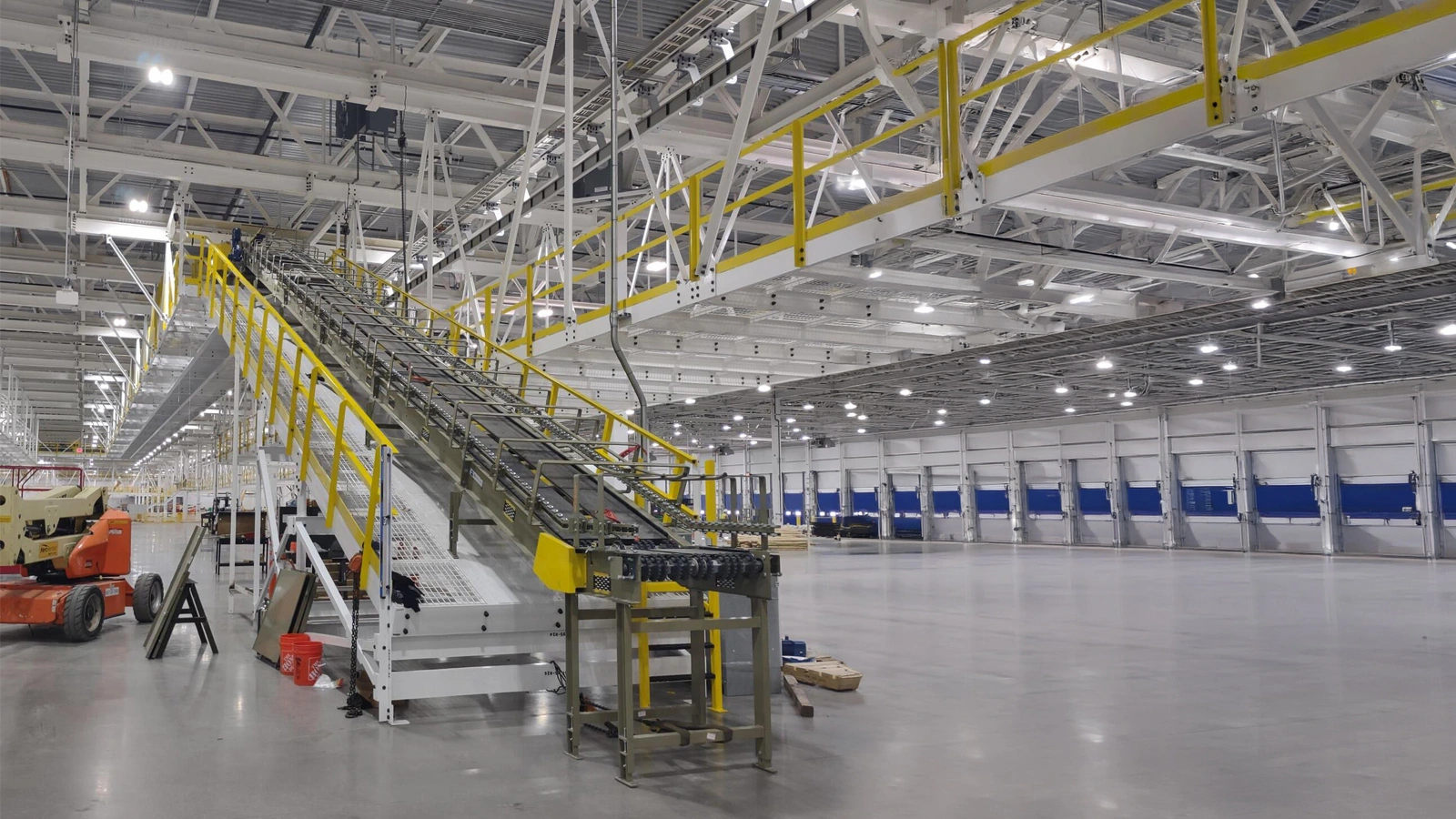
Walk through any active manufacturing facility and it’s clear that the movement of materials is just as important as the work being done on them. A stamping press that runs perfectly means little if parts cannot reach it efficiently, or leave it without creating a bottleneck downstream. Material handling conveyor systems keep that movement organized and consistent. They’re a critical part of the infrastructure in facilities where production runs on tight timing and tight tolerances.
This guide covers what material handling conveyor systems are, the most common types used across industrial environments, why automation has become central to modern conveyor design, and the role of conveyor installation and maintenance in long-term performance.
- Material handling conveyor systems are foundational infrastructure in high-production environments, where the movement of materials is as critical as the work being performed on them.
- Conveyor type selection depends on the application. Belt, roller, chain, overhead, and specialty conveyors each serve different load types, facility layouts, and production requirements.
- Automation adds consistency and speed by reducing variability in material flow, lowering the physical demands on workers, and integrating with production controls in ways that manual handling can’t.
- The design phase of material handling conveyors plays a major role in their performance. When a system is built around the facility’s current and future needs, it will always outperform a standard configuration adapted after the fact.
- Long-term conveyor performance depends on preventive maintenance and ongoing monitoring, which can be delivered by a partner who remains engaged after commissioning.
What Is a Material Handling Conveyor System?
A material handling conveyor system is a mechanized solution for moving materials, products, or components from one point to another within a facility. At its core, a conveyor system uses a combination of belts, rollers, or chains to transport items along a defined path. Many types of conveyor systems can be customized to meet a facility’s specific requirements, ranging from simple, manual systems to fully automated solutions.
Material handling conveyors are made up of a drive mechanism, belting or roller configuration, frame, tension controls, and operational controls. They work together to determine how much weight the system can carry, at what speed, over what distance, and under what environmental conditions. Getting that combination right for a specific application requires understanding the workflow the system is meant to support.
Common Types of Conveyors in Material Handling
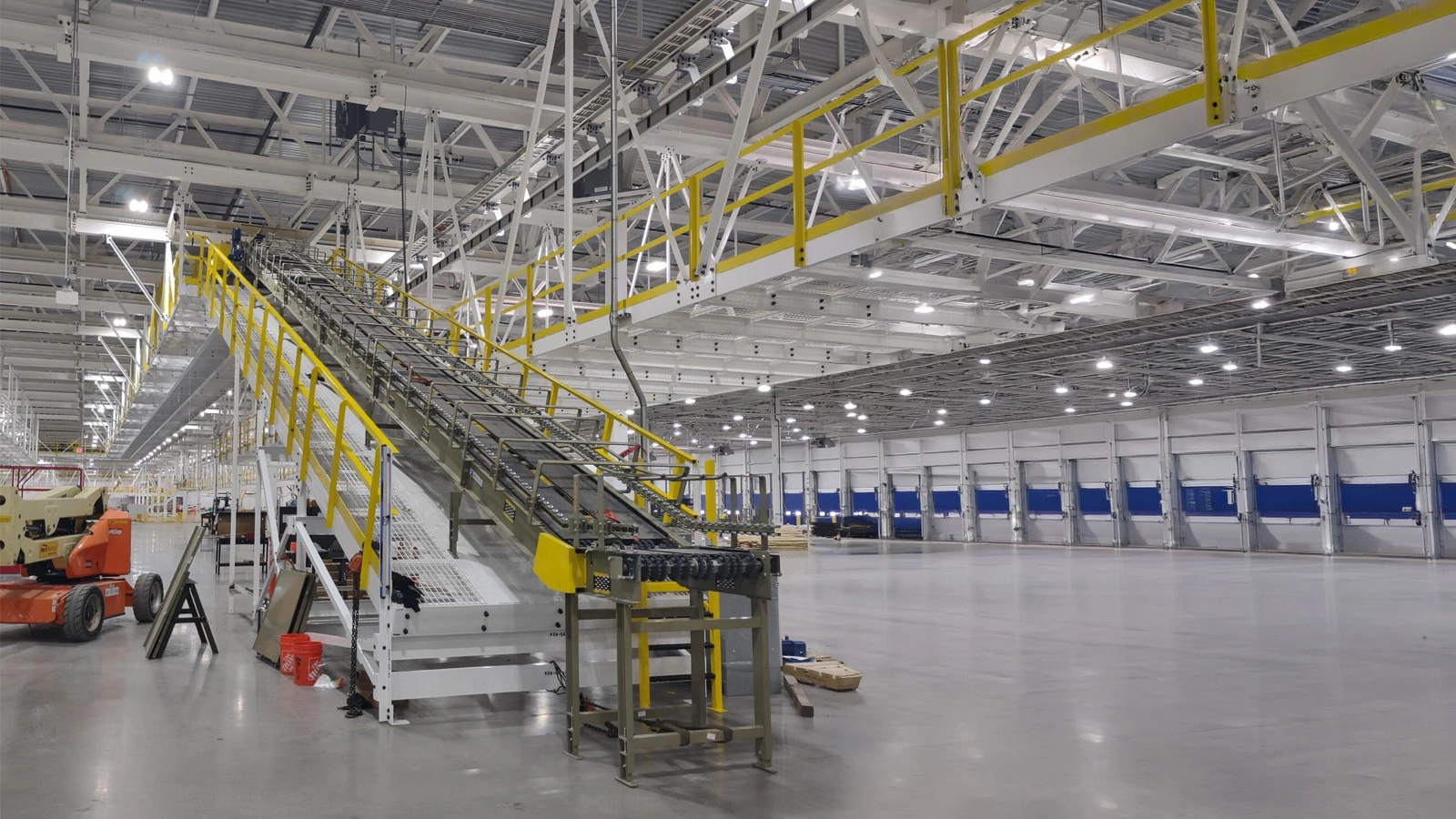
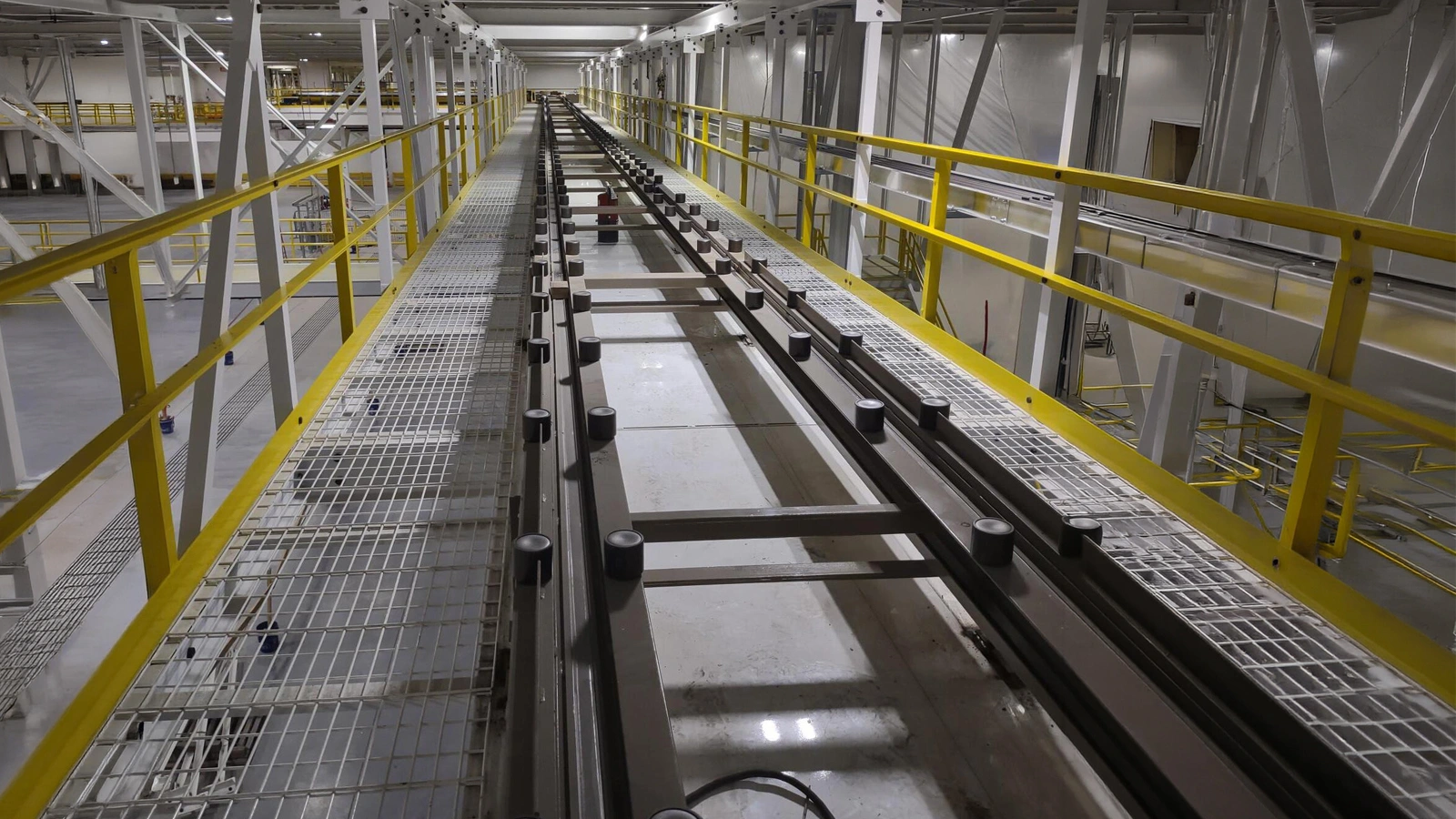
Different types of conveyors in material handling are engineered for various applications. The right choice depends on the material being moved, the layout of the facility, and the performance requirements of the operation. For example, if product accumulation is required to create a buffer, Power and Free, and roller flight conveyors are used. Here, carriers with product are banked while the chain moves continuously. Skillet conveyor systems are used if the operator must move with the product while working on it and if the product needs to be presented at varying heights in different workstations.
Belt conveyors are among the most widely used configurations across manufacturing and distribution environments. A continuous belt runs over a series of pulleys to carry items along a flat or slightly inclined path. They’re well-suited for moving a broad range of products reliably and at a consistent speed.
Roller conveyors use a series of rollers mounted on a frame to move materials. These can either be idler rollers, which support and manually move the load, or powered rollers, which move the load in auto mode using a drive. They’re ideal for heavy items like pallets and skids.
Chain conveyors use driven chains to move materials and are a staple in heavy-duty manufacturing settings. They’re often used in automotive manufacturing and for heavy items where belt systems wouldn’t provide the load capacity or surface traction required.
Overhead conveyors suspend materials from a track mounted above the work floor, freeing up floor space and allowing parts to move above active work areas. In automotive paint shops, for instance, overhead material handling conveyor systems carry vehicle bodies through coating processes continuously without interrupting the workflow below.
Screw and pneumatic conveyors serve more specialized applications involving bulk materials like granules and powders. They’re more common in food processing and chemical manufacturing settings.
Why Automation Matters in Modern Conveyor Design
Material handling conveyors have always improved efficiency by reducing manual work. Automated conveyor systems take that further by adding consistency and intelligence to the movement of materials.
Consistency is critical in high-volume production environments. When a system can route parts accurately and maintain consistent throughput, it removes variability from the equation. Variability in material handling creates delays and errors that are costly and time-consuming to recover from.
Automated conveyor systems also reduce the physical demands placed on workers. Manual handling of heavy or repetitive loads contributes to workplace injuries over time. Removing those tasks from the workflow is both a safety improvement and a workforce efficiency gain.
In many facilities, conveyor automation is deeply embedded into how production lines function. For example, in automotive facilities, vehicle bodies, assemblies, and components move through stamping, welding, painting, and final assembly in coordinated sequences that rely on material handling conveyor systems performing predictably at every stage.
Conveyor Installation: Why the Design Phase Is the Most Important One
A well-designed conveyor system can improve throughput and operate reliably for years. A poorly designed one creates new problems or moves old ones downstream. For example, a clearance issue can create challenges for maintenance teams, or a configuration may not be able to accommodate future changes to the production line.
The design phase is where most of that outcome is determined. Facility layout, ceiling height, existing equipment footprints, traffic patterns, load weights, and production sequencing all inform how a material handling conveyor system should be configured. When that analysis is done thoroughly before installation begins, the result is a system built around the facility’s actual workflows rather than a standard configuration adapted after the fact.
Sylvan’s approach to conveyor work reflects this directly. Rather than applying off-the-shelf solutions, our team works with facility operators to understand the constraints and performance requirements specific to each site. That means accounting for the space actually available, the equipment the conveyor needs to interface with, and the production volumes the system needs to sustain. We consider the role of these factors at launch and as operations evolve.
In practice, that kind of customization matters most when space is tight or when the conveyor needs to integrate with existing robotics or automated systems. Future changes to the production line are also important, since a conveyor designed with scalability in mind avoids the cost and disruption of a full redesign when it’s time to make those changes.
Conveyor Maintenance and Long-Term Performance
A material handling conveyor system’s value is realized over time, which means installation is only part of the equation. Ongoing maintenance, including the inspection of belting or roller surfaces, tension checks, lubrication of drive components, and monitoring of controls, determines whether a system performs consistently or becomes a source of unplanned downtime.
In high-production environments, unplanned conveyor downtime creates major disruptions to production. Production lines that depend on continuous material flow can be brought to a halt by a single system failure. Preventive maintenance programs, combined with operational monitoring, reduce that risk significantly.
Experienced conveyor installation and maintenance partners understand that their relationship with a facility doesn’t end at commissioning. Providing support for ongoing maintenance and system modifications as production needs change is part of what it means to operate as a long-term partner rather than a one-time contractor.
Choosing the Right Conveyor Partner
The technical specifications of a conveyor system matter just as much as the experience and approach of the team implementing it. Facilities that operate under tight production schedules, in complex multi-trade environments, with little tolerance for delays or errors, need a partner who has done this work before and understands what it takes to deliver in those conditions.
Sylvan brings decades of experience in industrial conveyor installation and maintenance, with services that include everything from turnkey design to 24/7 troubleshooting. If your facility is evaluating new conveyor infrastructure, reconfiguring an existing line, or planning for expansion, the conversation about the right solution starts with understanding your operation. Connect with our team to get started.