
Skyscrapers, the local elementary school, and an industrial warehouse can have very different exterior design aesthetics. But their interior structures are all made up of similar parts: steel. The infrastructure of most large buildings relies on a system of steel beams and supports at its core, covered with whatever materials are appropriate for the interior space. Getting all the steel beams and supporting pieces into place – making sure they are level, balanced, secured, and in the right place – is called steel erection.
This guide will provide an overview of the commercial steel erection process, including the key steps, safety considerations, and how steel erection professionals like Sylvan deliver safe, accurate, and budget-conscious execution.
Key Takeaways:
- Overview of the steel erection process
- Benefits of preconstruction components, like planning and design
- Safety guidelines and industry standards to consider
What is steel erection?
Steel erection is the process of connecting and installing steel components to form the load-bearing frame of a building. Steel parts, like columns and beams, are secured to the foundation of the building, then aligned and leveled, and finally bolted and welded into place. Steel erection requires a large team of skilled tradespeople – like structural engineers, architects, welders, and crane operators – whose work ensures the integrity and stability of the building.
Steel erection process
The process of structural steel erection begins long before cranes lift columns and beams into place. Investing time in a thorough planning and design process can save substantial costs and increase overall efficiency, while utilizing cutting-edge technology can improve accuracy and help maintain safer working environments.
“Today’s technology, like Building Information Modeling (BIM), allows us to see every detail of a project before we ever begin, which helps us to better predict issues that may arise. Having experts in things like BIM can help to save time on a build, and can also find opportunities for cost savings before raw material ordering and sequencing begins,” shared Eric Sauve, General Manager – Structural Steel, Canada.
Planning
The earlier steel erection professionals are involved in the project, the better. Engineers, architects, general contractors, fabricators, and erectors all have roles to play in the planning stages, and having a skilled company to manage all of those roles is critical. From drawing initial blueprints of column and beam connections to detailing the sequencing of assembly to managing steel and iron material procurement to incorporating mandatory safety protocols, the planning phase has the potential to set the project up for success. Industry veterans like Sylvan provide design, layout, and planning services, and can also help identify innovative cost-saving opportunities across materials and timeline when involved from the start of a project.
Fabrication and Site Preparation
Once plans are finalized and approved, the materials have to be fabricated. Columns, beams, trusses, and supports are cut, drilled, and shaped according to the engineer’s specifications. Before the steel arrives at the job site, the area needs to be prepared to support the machinery required – like cranes, excavators, and welding machines – and the machinery itself needs to be inspected and ready to work. Final checks to the foundation for accurate dimensions, balance, and stability help prevent issues down the line.
Craning and Assembly
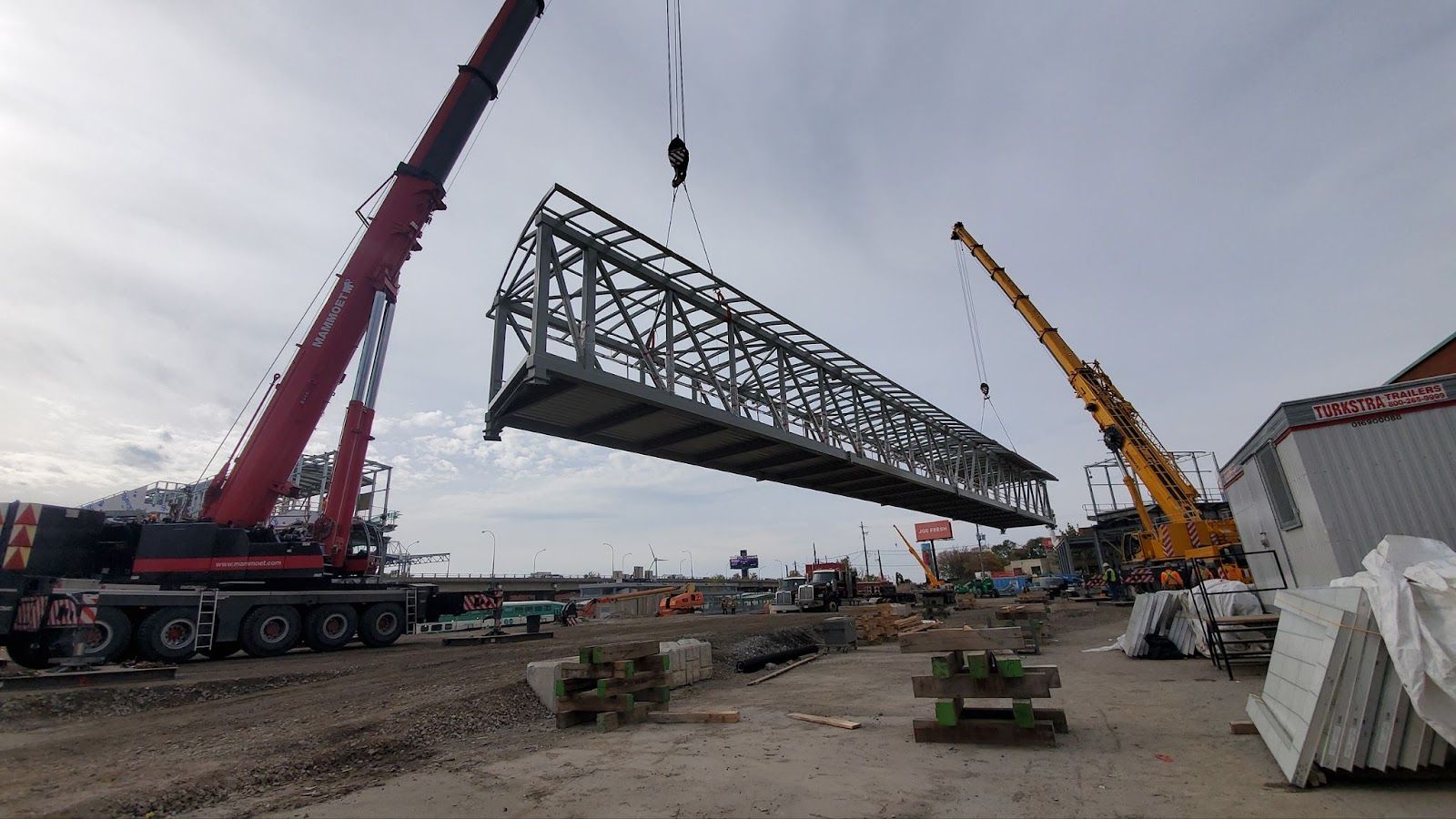
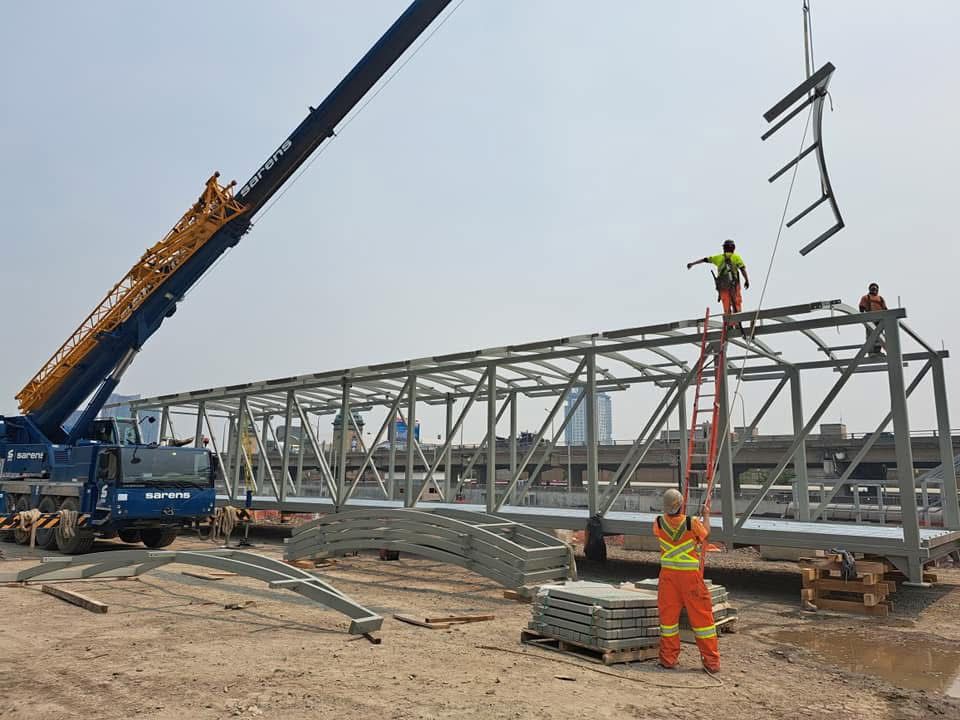
The sheer size and weight of steel infrastructure require the use of cranes. In conjunction with the rest of the crew, crane operators begin by lifting columns into place. Then, the team of steel erectors secures the columns to the ground plates and installs temporary bolts. Once they’ve confirmed that the columns are aligned and level, they install the permanent bolts and tighten them to the appropriate torque. Then, any welding is completed to provide increased support.
Sequencing
This process continues – setting and assembling columns – until it’s time to add in beams (horizontal components). Beams are set, bolted, torqued, then welded, and the basic frame begins to take shape. Establishing this sequence, or breaking up the full frame into smaller sections and then replicating steps, provides numerous advantages to the steel erection process. First, it decreases errors and safety risks by relying on repetition and a step-by-step approach. Next, it improves efficiency by allowing for entire segments of a build to be completed and cleared for the next trade to begin their work (framing, electrical, pumping, etc.). Trusted experts like Sylvan use technology to improve steel erection sequencing, which is imperative to a project’s schedule, as it’s one of the first portions of a build.
Quality Control and Safety
Inspections are built into every phase of the steel erection process because precision and safety are inseparable. Small misalignments at the base of a structure can cascade into major issues as a project arises, which is why Sylvan relies on advanced calibration tools, rigorous verification protocols, and continued field oversight. This disciplined approach ensures structural accuracy, regulatory compliance, and most importantly, the safety of every crew member on site.
That commitment is reflected in Sylvan’s safety performance, which consistently exceeds industry standards. With an Experience Modification Rate of 0.55 – nearly 45% safer than the industry average – and a Total Recordable Incident Rate well below 1.0, Sylvan demonstrates what a proactive, prevention-first safety culture looks like in one of construction’s highest-risk trades.
Sylvan is a trusted steel erection partner across warehouses, multi-level commercial buildings, and government and military facilities. By managing the entire process, from design coordination and material selection to final installation, Sylvan delivers efficiencies without compromising safety. When you partner with Sylvan, you’re choosing a team that protects your people, your schedule, and your investment. Reach out today to get started.
FAQs:
What is steel erection?
Steel erection is the process of connecting and installing steel components to form the load-bearing frame of a building. Steel parts, like columns and beams, are secured to the foundation of the building, then aligned and leveled, and finally bolted and welded into place. Steel erection requires a large team of skilled tradespeople – like structural engineers, architects, welders, and crane operators – whose work ensures the integrity and stability of the building.
How do you estimate the cost of a steel erection erection project?
Projects involving steel erection are calculated based on various factors. The total weight of steel used, or the tonnage, is a main determinant in the equation, and is the main way that projects are classified. In general, small projects are under 100 tons, medium projects are between 100 – 1,000 tons, and large projects are 1,00 – 5,000+ tons.